Do you know the story behind the Porro logo? The French magazine Ideat revisits the curious story of a few screws: the story of a visual identity that embodies the connection between Porro’s craftsmanship and Bruno Munari.
A look back at a curious story about screws—or rather, about a visual identity that tells the story of the connection between Porro's craftsmanship and Bruno Munari's boundless creativity.
By Oscar Duboÿ
At a time when brands rush to reinvent themselves through new identities supported by graphic guidelines and imagery, others prefer to remain faithful to their roots. Porro belongs to the latter group, continuing to emphasize not only its family-owned structure but, above all, its logo.
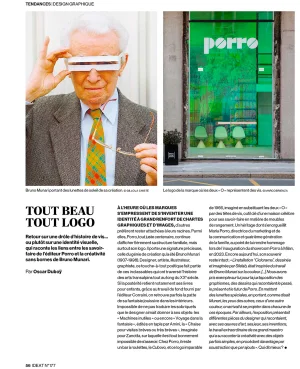
A precious signature created by one of the great genius of design: Bruno Munari (1907–1998). Designer, artist, illustrator and graphic designer, this poetic polymath belongs to that rare category of unclassifiable figures who shaped the history of Italian arts throughout the twentieth century.
Although he is best remembered for his children's books—thanks in part to the publishing work carried out by Corraini—his playful imagination can also be found in interiors and objects. It is impossible not to mention the nicknames he loved giving to his creations: the "Useless Machines", or "Journey into Fantasy", later adapted by Amini into carpets; or the famous "Chair for Brief or Very Brief Visits" designed for Zanotta, on which it is virtually impossible to sit.
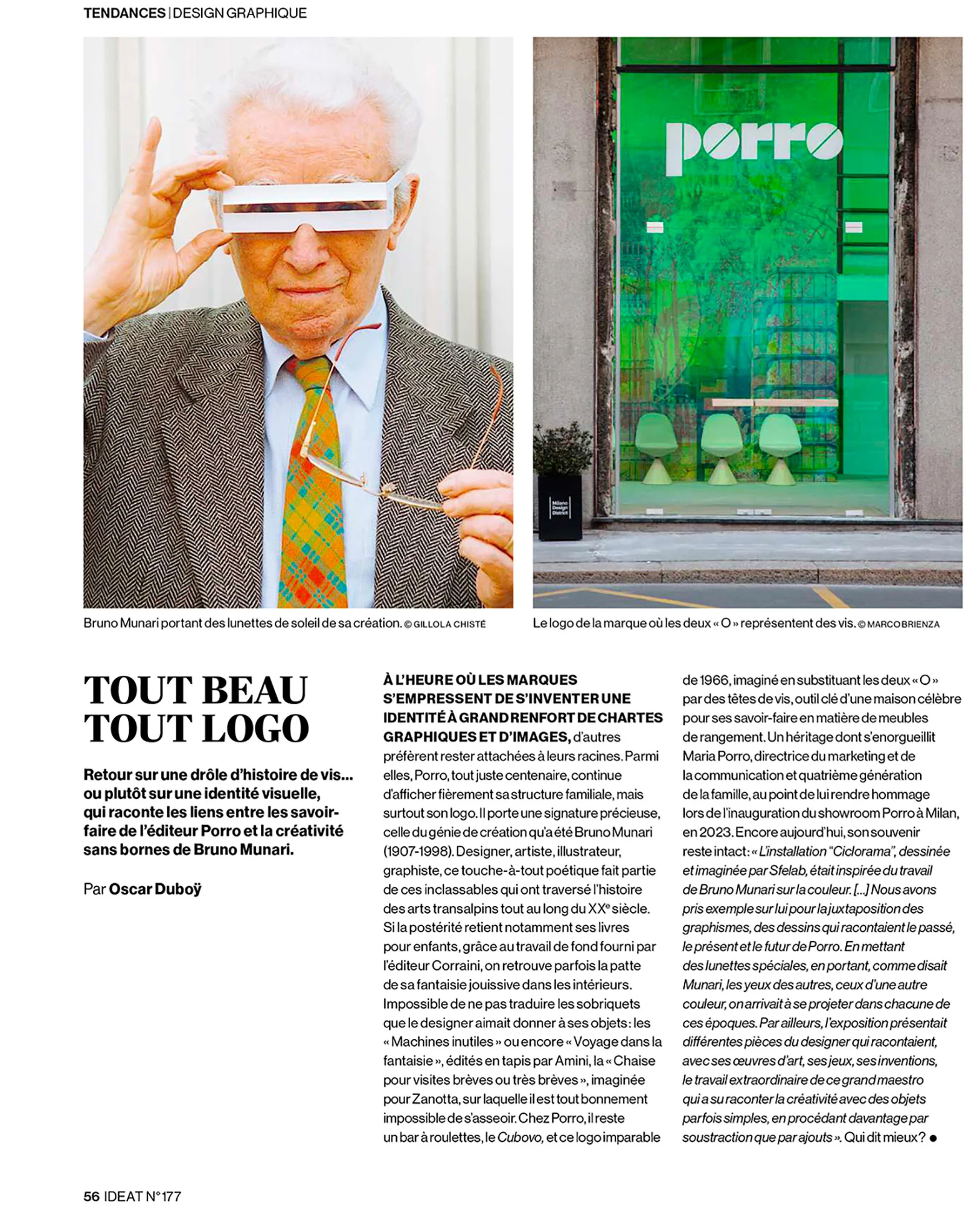
For Porro, his legacy survives in a wheeled bar cabinet, the Cubovo, and above all in the company's iconic 1966 logo, created by replacing the two "O"s with screw heads—a perfect symbol for a company renowned for its expertise in storage furniture.
It is a heritage that Maria Porro, Marketing and Communications Director and fourth generation of the family, is particularly proud of, to the point of paying tribute to it during the inauguration of Porro's Milan showroom in 2023.
Its memory remains vivid today:
"The Ciclorama installation, designed and conceived by Sfelab, was inspired by Bruno Munari's work on colour. We drew inspiration from his graphics and drawings, which tell the story of Porro's past, present and future. By wearing special glasses—as Munari might have done—and seeing through different eyes and colours, visitors were able to project themselves into each of these periods. The exhibition also featured several of the designer's works alongside his artworks, games and inventions. The extraordinary achievement of this great master was his ability to tell stories of creativity through objects that were sometimes extremely simple, working more through subtraction than addition. Who could do better?"
Tout Beau. Tout Logo
13.06.26